How AEO drives higher-intent site visitors than other channels
Answer engine optimization (AEO) is the practice of creating content for AI like ChatGPT, Claude, and Gemini to reference in their outputs. AI-referred traffic is small but growing fast and has an outsized impact on conversions. Traffic from AEO makes up less than 1% of overall traffic but converts 3x-15x better than traditional search, according to November 2025 data from Microsoft Clarity. While
本条来自 HubSpot Marketing Blog(marketing),聚焦 人工智能。 Dive into data about how marketers around the world are adapting to AEO and learn how to implement AEO yourself.
Answer engine optimization (AEO) is the practice of creating content for AI like ChatGPT, Claude, and Gemini to reference in their outputs
- How AEO drives higher-intent site visitors than other channels
- THE STATE OF AEO IN 2026
- Why AEO Visitors Demonstrate Higher Intent Than Other Traffic Sources
- Query Fan-out
- Dive into data about how marketers around the world are adapting to AEO and learn how to implement AEO yourself
Answer engine optimization (AEO) is the practice of creating content for AI like ChatGPT, Claude, and Gemini to reference in their outputs
AI-referred traffic is small but growing fast and has an outsized impact on conversions
Traffic from AEO makes up less than 1% of overall traffic but converts 3x-15x better than traditional search, according to November 2025 data from Microsoft Clarity
- Home
- Marketing
- How AEO drives higher-intent site visitors than other channels
How AEO drives higher-intent site visitors than other channels

THE STATE OF AEO IN 2026
Dive into data about how marketers around the world are adapting to AEO and learn how to implement AEO yourself.
Answer engine optimization (AEO) is the practice of creating content for AI like ChatGPT, Claude, and Gemini to reference in their outputs. AI-referred traffic is small but growing fast and has an outsized impact on conversions. Traffic from AEO makes up less than 1% of overall traffic but converts 3x-15x better than traditional search, according to November 2025 data from Microsoft Clarity. While the rest of the website world panics over declining traffic, savvy marketers like you are learning how to win high-intent traffic from AEO. Quality over quantity, right?
![Download Now: The State of AEO in 2026 [Free AI Search Trends Report]](https://no-cache.hubspot.com/cta/default/53/07ca2318-c9e0-4b5d-bcba-95cec5cb4958.png)
Visitors who find your site thanks to an AI answer engine are closer to buying than those who come from traditional channels. Here’s proof:
- ChatGPT referrals convert at 11.4% versus 5.3% for organic search across ecommerce sites (Similarweb 2025 research).
- Copilot’s subscription conversion rate was 15x that of traditional search and outperformed traffic from direct and social. (Microsoft Clarity study, November 2025)
- AI search use is the single strongest predictor of purchase intent for CRM software buyers. (Global HubSpot survey, January 2026)
The age of AI is a huge opportunity to sway LLMs in your favor, get them to essentially pre-qualify your leads, and send the highest-converting ones your way. And this article will be your guide.
- Why AEO Visitors Demonstrate Higher Intent Than Other Traffic Sources
- How to Compare AEO Visitor Intent Against Other Channels
- How to Measure AEO Visitor Quality in Your CRM
- How to Use Intent Scoring to Quantify AEO Visitor Advantage
- Which Metrics Prove AEO Drives Higher-Intent Visitors
- How to Build a Channel Comparison Framework for AEO
- How to Start Proving AEO Visitor Quality Today
- Frequently Asked Questions About AEO Visitor Intent
Why AEO Visitors Demonstrate Higher Intent Than Other Traffic Sources
Answer engines deliver comprehensive results based on the user’s intent and with deep context, rather than just matching explicit keywords. This can basically pre-qualify your leads before any click occurs. A visitor who lands on your site has already been matched to your content as the answer, not served it as one of ten possible options.
Query Fan-out
Query fan-out condenses research by resolving several related and inherent sub-questions in a single exchange. The engine anticipates and runs the sub-searches a person would otherwise type one at a time, then returns a single synthesized answer. A buyer who once needed five queries to weigh their options gets one resolved response, which ends the back-and-forth that defined traditional research sessions.
The State of AEO in 2026
- Optimizing for answer endings.
- Making purchases based on brands discovered through answer engines.
- Improving brand citation from doubling down on AEO.
- And more!
Download Free
All fields are required.
You're all set!
Click this link to access this resource at any time.
Further Along the Customer Journey
Because answer engines handle the early research inside the chat, the visitors who click through have already cleared the definitional stage. Copilot ads for lower-funnel journeys convert 76% higher than traditional search ads, according to Microsoft Advertising. Organic search still delivers a broad mix of early-stage and navigational visitors, so the same click count carries lower average intent.
A Different Journey Than Traditional Search
When Robert Carnes ran hundreds of queries across answer engines, he found that AI isn’t replacing search so much as merging with it. Answer engines increasingly resolve the question up front and cite sources without sending the click.
Traditional search scatters the same research across many separate sessions, each with its own round of clicks. Because the answer engine has already resolved that loop, the visitors who do click arrive with most of their questions answered.
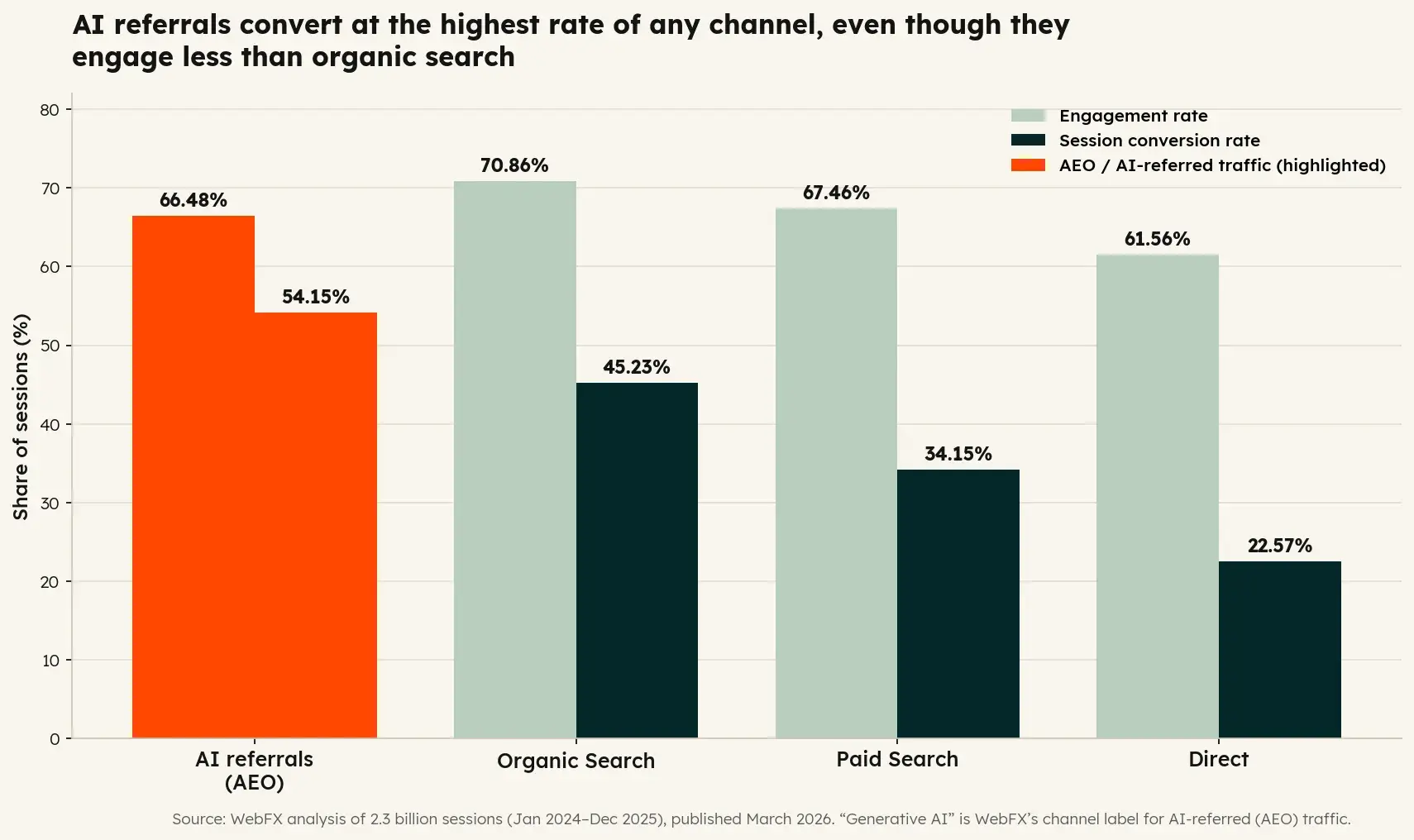
That advantage surfaces directly in your analytics. Higher-intent visitors convert at higher rates and move through the pipeline faster than paid, organic, or social traffic. A March 2026 WebFX analysis of 2.3 billion sessions found AI visitors converted roughly 1.2x higher than organic and outperformed every other free channel. The sections ahead trace each intent signal, how to benchmark it against other channels, and how to follow AEO visitors from first session to closed deal.
How to Compare AEO Visitor Intent Against Other Channels
Intent doesn’t show up as a single number. It surfaces as a pattern across engagement, source behavior, and downstream conversion, and the comparison only holds up when you measure the same signals across every channel.
Which Intent Signals Reveal AEO Visitor Quality
Four GA4 signals separate high-intent traffic from the rest:
- Average engagement time
- Engaged sessions per active user
- Views per session
- Key event completions
Read together, these intent signals show whether a visitor explored with purpose or left after one glance. Because answer engines pre-qualify visitors before the click (covered earlier), AEO traffic tends to cluster at the high end of these signals rather than the navigational low end organic search produces. Add returning-user rate and scroll depth, and the line between a buyer running a real evaluation and a drive-by visitor gets sharper.
How to Benchmark AEO Engagement vs. Organic Search, Paid, and Social Traffic
Google introduced a new AI Assistant channel in May 2026. When GA4 recognizes traffic from an AI assistant, it can assign the session an ai-assistant medium automatically, with no setup required. Early visibility may vary by property, though, so don’t assume a missing or empty AI Assistant row means you have no AEO traffic. Some AI-referred visits may still appear under Referral, Unassigned, or Direct.
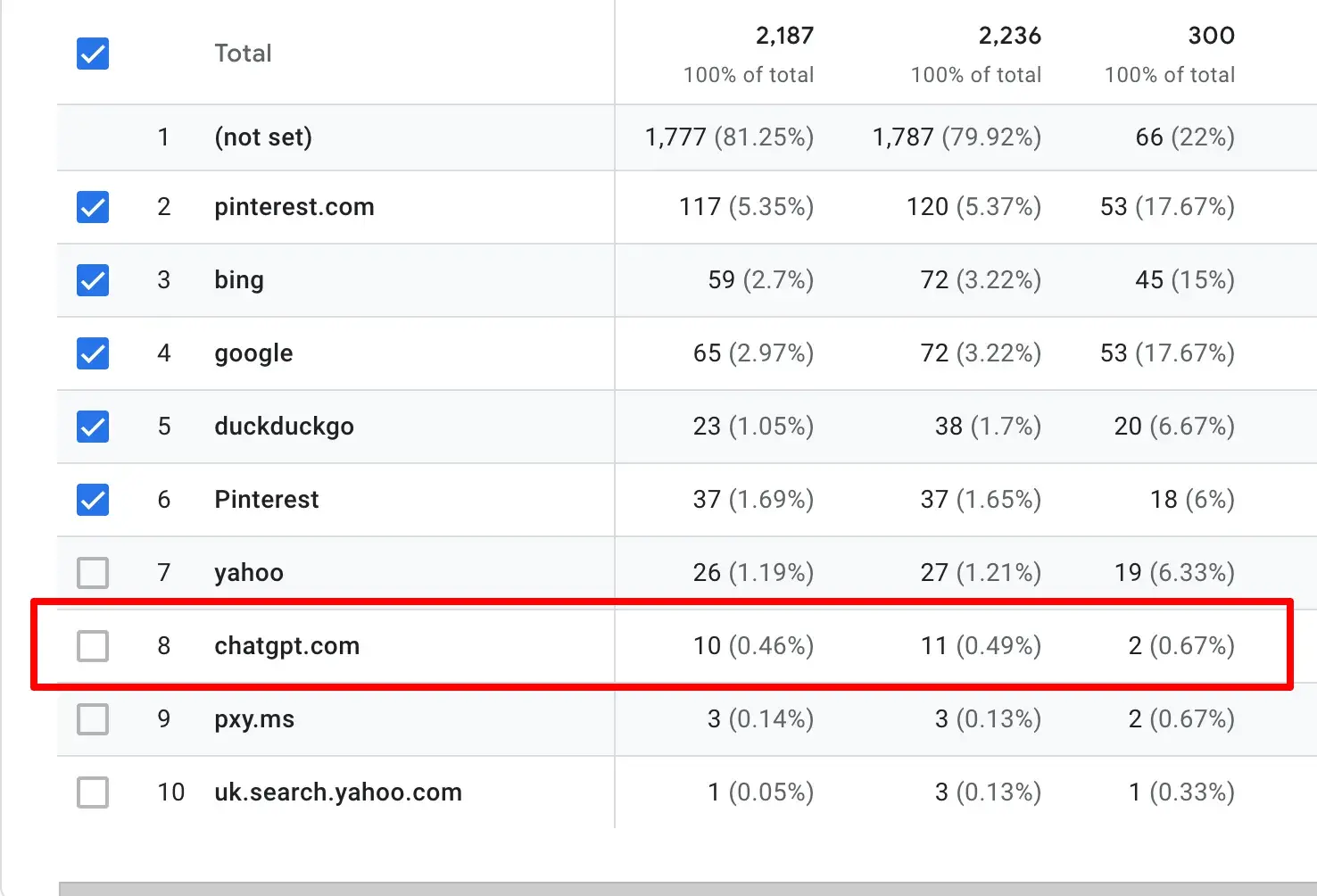
Pro tip: Some answer engines show up in your source data without any configuration as [domain] / referral, as long as the referrer survives the click. ChatGPT search result clicks can be easier to identify because OpenAI says ChatGPT automatically adds utm_source=chatgpt.com to referral URLs. That UTM can preserve attribution when referral data is unreliable, assuming the parameter survives redirects and landing-page processing.
Here’s what that ChatGPT referral traffic looks like in my Google Analytics dashboard:
To benchmark AEO traffic against search and social, you first need to find it. Below are three ways to do that in GA4, from fastest diagnostic check to a cleaner reporting setup.
Option 1: Spot-check with Session Source / Medium.
Before you build anything, you can gauge the volume in seconds:
- Open Reports > Traffic acquisition.
- For primary dimension, select Session source / medium.
- Search chatgpt, perplexity, claude, and gemini to see roughly how much answer engine traffic you’re getting.
This quick check tells you whether there’s enough volume to justify the setup in Option 2.
Option 2: Build a custom channel group.
This is the workaround many SEOs use when the native channel is unavailable or incomplete. It’s also worth keeping after the native channel appears, because a custom regex can catch additional source patterns you see in your own data. You’ll need Editor or Administrator access to the GA4 property.
- Open Admin > Data Display > Channel Groups and click Create new channel group.
- Add a channel and name it something like “AI Search.”
- Add a condition group: set Source to matches regex, then paste a pattern covering the major answer engine domains you want to track: chatgpt\.com|chat\.openai\.com|perplexity\.ai|claude\.ai|gemini\.google\.com|copilot\.microsoft\.com|deepseek\.com|grok\.com|meta\.ai|you\.com
- Move the new channel above Referral in the list.
- Save. You can apply custom channel groups retroactively to existing GA4 data. That way, you can analyze past traffic instead of waiting for a forward-only baseline.
Option 3: Use the native AI Assistant channel (if available).
If the native channel has reached your property, it’s the lowest-maintenance option:
- Open Reports > Acquisition > Traffic acquisition.
- Set the primary dimension to Session default channel group.
- Look for the AI Assistant row beside channels like Organic Search, Paid Search, and Organic Social.
Pro tip: Any method will undercount true answer engine influence. AI visits that arrive without a referrer header, such as clicks from in-app browsers, copied links, or privacy-restricted environments, may still fall into Direct, as Search Engine Journal points out. Treat the native AI Assistant channel as a cleaner signal, not a complete count of AEO-influenced traffic.
Whichever method gets you there, the comparison runs the same way: Line AI Search or AI Assistant traffic up against Organic Search, Paid Search, and Organic Social, compare the same engagement signals across one date range, and use one primary conversion goal for the headline benchmark. Then add secondary key events by funnel stage so you don’t over-credit or under-credit channels that play different roles.
How Condensed Search Paths Translate to Higher Conversion Readiness
It may seem counterintuitive, since multiple touchpoints were traditionally seen as necessary for warming up leads. But when an answer engine resolves the research loop inside the chat through query fan-out, much of that warming happens before the visitor ever reaches your site. Fewer sessions to conversion then reads as higher readiness, not weaker engagement. The next section shows how to measure that compression directly, so you can prove it against organic, paid, and social rather than infer it.
The State of AEO in 2026
- Optimizing for answer endings.
- Making purchases based on brands discovered through answer engines.
- Improving brand citation from doubling down on AEO.
- And more!
Download Free
You're all set!
How to Measure AEO Visitor Quality in Your CRM
Isolating the channel was step one. Turn traffic into proof with tracking in your CRM.
How to Track AEO Visitor Progression from Session to Contact to Closed Deal
GA4 can show acquisition, engagement, key events, and attribution paths, but it usually can’t prove B2B pipeline quality or closed-won revenue on its own. To connect AEO traffic to contacts, deals, and revenue, the source needs to carry into your CRM.
HubSpot Smart CRM tracks a visitor’s activity before they’re ever added as a contact. Once they convert, HubSpot associates the new contact record with that earlier anonymous activity, so the Original Traffic Source reflects their first visit rather than the session when they filled out a form. Deals inherit that attribution automatically, since the Original Traffic Source on a deal pulls from whichever associated contact has the oldest recorded activity.
HubSpot also classifies AI Referrals as a distinct traffic source. When a visitor clicks a cited link inside a ChatGPT, Claude, Perplexity, or Gemini response, HubSpot tags that session as AI Referrals with no custom configuration required.
So the thread GA4 can’t complete on its own (e.g., an answer engine visit followed to contact and then to a closed-won deal with the source preserved) runs end to end inside HubSpot whenever the visitor can be tracked and associated.
How to Use Intent Scoring to Quantify AEO Visitor Advantage
Intent scoring combines several signals into one comparable figure per session. Assign point values to the behaviors that mark a serious evaluator: clearing your median engagement time, hitting a target scroll depth, viewing a pricing or comparison page, and completing a key event. Sum the points per session, then average the score by channel.
Built this way, the score does two things a raw conversion rate can’t. It captures intent before a visitor converts, so you can judge a channel even when its volume is too low for a conversion rate to stabilize. And it holds every source to one rubric, which is what makes “AEO visitors are higher intent” an auditable claim rather than an assertion.
HubSpot AEO tracks how your brand appears across ChatGPT, Perplexity, and Gemini, which tells you whether answer engines surface the pages your highest-scoring visitors land on. Pairing that visibility view with your channel intent scores connects what answer engines cite to the quality of the traffic they send.
Which Metrics Prove AEO Drives Higher-intent Visitors
The proof already lives in your GA4 and CRM. Turning it into a case a skeptical stakeholder can’t dismiss takes two moves:
- Optimize for the metrics where AEO wins. Volume isn’t one of them. Quality is.
- Consolidate the winning metrics into one channel comparison. So the case reads at a glance instead of being scattered across five dashboards.
How to Optimize for AEO Visitor Quality, Not Just Volume
AEO sends fewer visitors than organic, paid, or social, so the play is to optimize for quality. Here are three ways to do just that:
1. Anticipate the query fan-out.
Answer engines don’t just answer the user’s question. They split it into sub-queries and resolve each one before synthesizing a response (covered earlier). Help your page show up in the citation by addressing the full fan: the original question plus every related sub-query a buyer would ask next.
- Map the sub-queries a real buyer types around your primary keyword. If you need ideas, Otterly’s free fan-out tool predicts the sub-queries AI answer engines are likely to generate.
- Cover them in one comprehensive page, not scattered across five thin posts.
- Prioritize the sub-queries that carry purchase intent: comparisons, pricing, integrations, and decision criteria.
2. Write for buyer prompts, not generic search queries.
本条目归入「Technology AI」垂直,涉及真实话题:人工智能。
· 市场:关注 人工智能 对相关品类与竞争格局的潜在影响。
· 消费者:微软 Microsoft 的受众行为与偏好变化值得追踪。
· 品牌:微软 Microsoft 的叙事、产品与增长动作可拆解复用。
· 渠道:内容分发与触点组合(社媒 / 电商 / 线下)的协同值得复盘。
· 涉及品牌:微软 Microsoft。
· 核心话题:人工智能。
· 可思考:如何把「人工智能」的洞察,转化为可衡量的内容与增长动作?
面试中可引用「How AEO drives higher-intent site visitors than other channels」:围绕 微软 Microsoft,说明你对行业动向的判断与可落地动作。
本条目相关英文术语可在「商务英语」模块按话题检索,用于外企面试表达训练。
HubSpot AEO tracks how your brand appears across ChatGPT, Perplexity, and Gemini, which tells you whether answer engines surface the pages your highest-scoring visitors land on. Pa…
GA4 can show acquisition, engagement, key events, and attribution paths, but it usually can’t prove B2B pipeline quality or closed-won revenue on its own. To connect AEO traffic to…
Answer engine optimization (AEO) is the practice of creating content for AI like ChatGPT, Claude, and Gemini to reference in their outputs. AI-referred traffic is small but growing…